


Internet fails in movies: Hollywood ‑ best provider in the world?
to read 6 min
- Speed of internet in movies: TOP-3 cinematic myths
- Myth 1: Instant downloading of gigabytes of data
- Myth 2: Indicator of downloading as a clock
- Myth 3: One click – and access to any system
- Real speed of internet: what affects downloading?
- Ping and speed: in what difference?
- The main factors that affect the speed of the internet
- How internet providers ensure real speed
- Technologies, that make internet faster
- Why can speed differ from declared?
- Let’s sum up
Recall favorite Hollywood blockbusters, where the main hero downloads secret files in several gigabytes with incredible internet speed in just three seconds, a hacker penetrates the Pentagon's system with one click, and the indicator of downloading instantly jumps from 0 to 100%. Looks spectacular, true? And now recall how much time you need to download an ordinary movie or update of a game. Noticeable difference, isn’t it?
Do you wonder, why in real life all works completely otherwise? Let’s figure out how in reality the internet works and why directors slightly embellish the internet in their films.
Speed of internet in movies: TOP-3 cinematic myths
So what about embellishing the film industry?

Myth 1: Instant downloading of gigabytes of data
Remember the scene from "Mission Impossible", where the main hero Ethan Hunt (Tom Cruise) downloads a database of the CIA in counted seconds? Or how in "Hackers" computer geniuses transfer terabytes of information faster than you manage to eat popcorn? Sounds unreal even for fiber-optic internet.
In reality wired home internet with speed 1 Gbit/s requires at least:
- 8 seconds for downloading a 1 GB file;
- 2 minutes for a movie in 4K quality (15 GB);
- An hour for a modern AAA game (60-100 GB).
If all works ideally and the server can give data at maximum speed. And so it does not always!
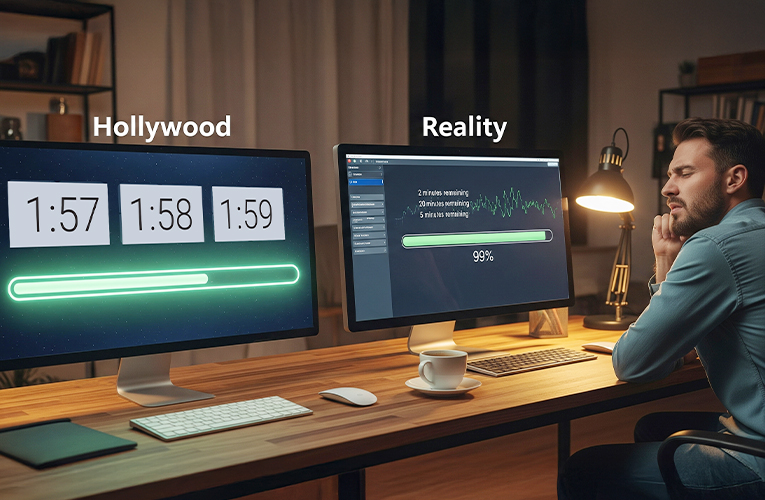
Myth 2: Indicator of downloading as a clock
In movies, the speed of the internet appears stable, and the download progress bar moves evenly, always showing the exact time to completion. In life, we are accustomed to phrases like "5 minutes... 2 hours... again 3 minutes".
Real indicators of downloading:
- often show approximate time;
- can "hang" at 99% longer than the downloaded first 90%;
- speed constantly changes depending on the load on the server;
- "2 minutes remain" easily turns into 20 minutes.
In cinema, this would look boring; therefore, directors make everything beautiful and predictable. And to us remains to wait and to hope!
Myth 3: One click – and access to any system
"I entered!" – shouts cinematic hacker, pressing Enter after 10 seconds of tapping on the keyboard. The screen instantly fills with secret data, and security does not even manage to understand what happened.
Reality is much more prosaic:
- Hacking a protected system can take months or years.
- Most "hacks" happen through social engineering, and not through super-hacker skills.
- Real systems of security have multi-level protection.
- Even having received access, you need time to search for the needed information.
But who would watch a movie where a hacker spends three months searching for vulnerabilities in a system?
Real speed of internet: what affects downloading?
Now let’s consider the main reasons why the internet can work slowly/quickly.
Ping and speed: in what difference?
Before trying to figure out the speed of the internet, it is important to understand basic concepts.
Ping – this time of response, for which data reaches the server and returns. Measured in milliseconds (ms) and then less indicator, that is better:
- to 20 ms – excellent (ideal for online games);
- 20-50 ms – good (comfortable work with the internet);
- 50-100 ms – satisfactory (possible slight delays);
- over 100 ms – bad (noticeable lags).
Speed of downloading – how much data you can receive per second. Measured in megabits (Mbit/s) or gigabits (Gbit/s) per second.
Speed of uploading – how much data you can send per second. Usually, it is less than the speed of downloading.
The main factors that affect the speed of the internet
So, what depends on the speed of the internet?
1. Your tariff plan
When you see advertisements of tariffs on the internet, "speed to 1 Gbit/s", the keyword here is "to". This is the maximum possible speed in ideal conditions. In reality, you can receive:
- 70-90% from declared speed – this is absolutely normal;
- 50-70% – satisfactory, but worth figuring out with reasons;
- less than 50% – definitely are problems.
Absolutely all providers work by the principle "maximum efforts" – do all possible, but not guarantee a specific speed 24/7.
2. Quality of equipment
Your Wi-Fi router can become "Achilles’ heel" even with the presence of fast internet from the provider:
- The old router of standard 802.11g limits speed to 54 Mbit/s.
- Cheap routers can "lag" at large loads.
- Poorly located router not able to provide a stable signal throughout the apartment.
- An Ethernet cable of category Cat5 limits speed to 100 Mbit/s.
3. Server of source
Even if you have gigabit internet, downloading will be slower if:
- the server, your address, is overloaded by other users;
- the server located geographically far (data goes longer);
- the server has limited bandwidth;
- the server artificially limits the speed for each user.
Exactly, therefore, YouTube loads quickly (powerful servers of Google), and some file-sharing can work slowly.
4. Time of day and load of network
Internet providers calculate the network on average load, and not on that, to all users simultaneously using maximum speed.
Peak hours(19:00-23:00): all watch YouTube or BRIZ.TV, children play in online games, and adults work from home – the speed of the internet can slow down if the home internet is overloaded in peak hours. This time is especially important to have sufficient speed: tariff 500 Mbit/s and higher provides comfortable work of several devices simultaneously, and tariff 1000 Mbit/s allows the entire family to enjoy digital TV in 4K or 8K quality without delays or freezes.
Non-peak hours(night, morning): the network is less loaded, can receive speed, close to maximum, ideal time for downloading large files.
How internet providers ensure real speed
Let’s consider the real, “non-cinematic” speed of the internet.
Technologies, that make internet faster
Modern providers use different technologies to ensure stable speed.
Fiber-optic internet – light pulses transmit data at a speed close to the speed of light. At the moment of writing this article, this is the fastest technology for home internet.
Cache-servers – providers install local copies of popular content (YouTube, BRIZ.TV), so it loads faster.
Balancing of load – traffic is automatically directed to the least loaded routes.
Why can speed differ from declared?
When seen on the tariff inscription "to 1000 Mbit/s", this is not a marketing trick or attempt at deception. These legal requirements and technical realities are simultaneously.
Legal accuracy
The National Commission, which carries out state regulation in spheres of electronic communications, radio frequency spectrum, and provision of postal services (NCEC) in Ukraine, like European regulators, requires providers to indicate the maximum possible speed, and not guarantee a fixed speed. So, wording "to 1000 Mbit/s" means that in ideal conditions you receive maximum speed, but in reality it can be lower. If the provider wrote "always exactly 1000 Mbit/s" – this would look like deception, because such a promise is technically unrealistic.
Technical features of the work of the network
The Internet works by the principle of "shared resource" – this is like a car road, which is used by all simultaneously. The channel of providers is divided between many users, and the load constantly changes: in the day, fewer people are online, in the evening (19:00-23:00), peak load. Therefore, actual speed fluctuates throughout the day.
Also affect home factors:
- quality of your router and its settings;
- use of Wi-Fi instead of a wired connection;
- number of simultaneously connected devices;
- the distance from the router to your gadgets.
Honesty instead of marketing
"To 1000 Mbit/s" – this is an indicator of the upper limit, which in most cases is available, but not guaranteed 24/7. This is not deception – this transparent information about possibilities of the network with consideration of real conditions of operation.
Let’s sum up
So, in the cinematic world, the speed of downloading is a part of the plot, and in real life, it is an important technological characteristic.
Hollywood creates beautiful pictures, where technologies work as needed for drama. In reality, the internet is governed by laws of physics, the laws of networks, and limitations of equipment.
But know what? The real world is not less exciting! When you understand, how works your home internet and what factors affect on speed, you can:
- Correctly choose a tariff plan.
- Set up a home network for maximum speed.
- Plan large downloads for non-peak hours.
- Understand when the problem is in the provider, and when it is in your equipment.
If you are tired of cinematic illusions and want real speed, internet provider BRIZ offers real solutions. Our network of fiber-optics ensures a stable internet without exaggerations and marketing tricks.
Receive information about promotions and news from BRIZ to your email address

Be the first to comment