


Internet provider BRIZ in Odesa
to read 6 min
- BRIZ coverage across Odessa districts
- BRIZ technologies: how fiber-optic internet works
- XG-PON: why do you need 2.5 Gbps internet at home?
- Internet during blackouts: why it is critical for Odessa
- How BRIZ monitors connection quality
- What actually affects internet speed and how to measure it
- Home internet tariffs in Odessa
- Frequently Asked Questions
Odessa is a large coastal city with over 30 km of shoreline, four districts, and thousands of apartment buildings and private houses. Just like water or electricity, every home needs fast and stable internet access. This is exactly what BRIZ provides through its modern fiber-optic network built using GPON and XG-PON technologies. Home internet from BRIZ is available in the Primorskyi, Kyivskyi, Khadzhibeyskyi and Peresypskyi districts with speeds up to 2.5 Gbps, and up to 10 Gbps on request.
Fiber optics represent a completely different level compared to the old copper networks that were widely installed across Odessa in the early 2000s. Data is transmitted not by electrical current but by light through a glass fiber only 125 micrometers thick (thinner than a human hair). The light signal travels at speeds of up to 200,000 km/s and does not create electromagnetic interference. The result is a stable connection without signal degradation over distance and internet that can continue working even during power outages (provided the ONU terminal and router are powered by a UPS).
Below you will find detailed information about BRIZ network coverage in each district of Odessa, a comparison of technologies, current tariffs and a step-by-step connection guide.
BRIZ coverage across Odessa districts
The BRIZ network covers all four main districts of Odessa. Its fiber-optic infrastructure provides stable connectivity with minimal signal latency. Check if connection is available at your address on the coverage map.
BRIZ technologies: how fiber-optic internet works
The BRIZ network is based on GPON (Gigabit Passive Optical Network) technology — an international ITU-T G.984 standard used by leading telecom operators in more than 150 countries worldwide. Instead of copper cable, fiber optic cable is installed directly to your apartment, transmitting data via a beam of light over distances of up to 20 km without a single signal amplifier.

Internet during power outages
GPON – speed and reliability!
High speed, reliable signal and stable operation even without electricity. Connect GPON and stay online in any situation.
Learn more- GPON – up to 1 Gbps. Most internet providers in Odessa offer this speed in their highest tariff plans.
- XG-PON – up to 2.5 Gbps (up to 10 Gbps individually on request). BRIZ introduced this technology as one of the first providers in Odessa. A 10 GB file downloads in about 32 seconds — twice as fast as on a gigabit tariff. Thanks to the development of its own infrastructure, BRIZ made multi-gigabit internet available not only for business clients but also for home users.
- Internet during blackouts. Odessa regularly experiences power outages due to damage to energy infrastructure. Copper networks shut down because every switch requires power. Fiber works differently: there are no active elements requiring electricity between the network node and the building. BRIZ nodes are equipped with backup batteries and generators, and with a mini-UPS powering the home ONU terminal and router, users can stay online even during long outages (100+ hours).
- 24/7 support. BRIZ technical specialists work around the clock. Connection for new subscribers takes 1–3 working days from request to active internet service.
- Internet + BRIZ.TV. All internet tariffs include access to the BRIZ.TV online cinema — more than 170 TV channels in digital quality. One subscription instead of several streaming services.
XG-PON: why do you need 2.5 Gbps internet at home?
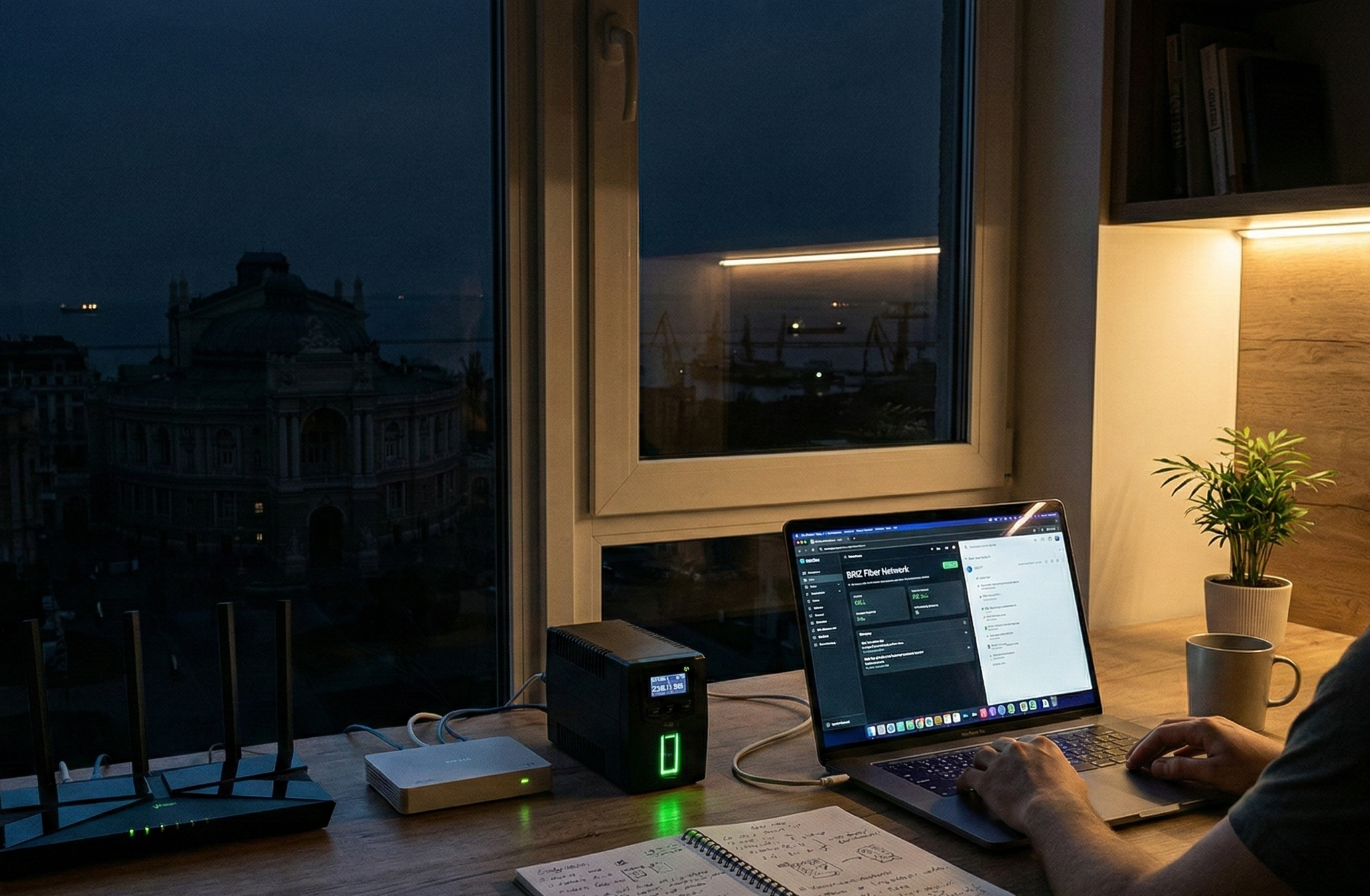
Most families in Odessa now have at least 8–12 devices connected to Wi-Fi simultaneously: smartphones, laptops, Smart TVs, tablets, smart speakers, security cameras and more. Each Netflix stream in 4K consumes at least 25 Mbps, a Zoom conference in HD uses another 4–5 Mbps, and downloading a game from an online library can significantly affect connection speed for other devices. With the TURBO 2.5G tariff, all these activities can run simultaneously without competing for bandwidth.
Internet during blackouts: why it is critical for Odessa
Odessa has experienced dozens of large-scale blackouts. Some lasted several hours, others several days. Under such conditions, stable internet is not just about comfort but a necessity: communication with family, emergency alerts, remote work and online education.
BRIZ equipped all key network nodes with lithium iron phosphate batteries (LiFePO4) — a technology with more than 3,000 charge cycles — and connected them to generators. For home autonomy, a mini-UPS starting from 12 W is enough to power the ONU terminal and router for 4–8 hours during outages. This proven solution already helps thousands of Odessa residents stay connected.
How BRIZ monitors connection quality
The monitoring system works 24/7 and automatically tracks the condition of every connection. Each ONU terminal sends diagnostic data to the central platform including optical signal level (Rx power), error rate and module temperature. If the signal level drops below the threshold, engineers receive an alert before the subscriber notices a problem. Most incidents are resolved proactively without support requests.
What actually affects internet speed and how to measure it
The speed specified in a tariff plan represents the bandwidth of the optical channel to your ONU terminal. Actual speed on a device depends on several factors beyond the provider's control:
- Cable vs Wi-Fi. For accurate measurement connect a laptop directly to the router using an Ethernet cable. Wi-Fi is always slower due to radio channel physics — even modern Wi-Fi 6 or Wi-Fi 7 standards cannot guarantee the full tariff speed.
- Wi-Fi frequency. 5 GHz provides higher speed but shorter coverage. 2.4 GHz provides wider coverage but lower speed and more interference from neighboring networks.
- Walls and obstacles. A concrete wall can reduce Wi-Fi signal by 50–70%. For apartments larger than 60 m² or with complex layouts, a Mesh system is recommended instead of a single router.
- Speed testing. Use Speedtest by Ookla or Fast.com. Test via cable, close other applications and repeat tests 2–3 times at different times of the day.
Home internet tariffs in Odessa
All BRIZ tariffs are the same across every district of Odessa — from Primorskyi to Peresypskyi. The minimum speed in any plan is 100 Mbps, which is enough for 4–5 devices simultaneously.
More details about tariffs and special offers can be found on the Home Internet page.
Frequently Asked Questions
-
What is the maximum internet speed at BRIZ?
The maximum speed in the TURBO 2.5G tariff is 2.5 Gbps thanks to XG-PON technology. Up to 10 Gbps is available on request. -
Is BRIZ available in my district?
BRIZ operates in the Primorskyi, Kyivskyi, Khadzhibeyskyi and Peresypskyi districts of Odessa and the surrounding region. -
How much does connection cost?
Connection to the BRIZ network starts from 100 UAH. -
Can I connect internet together with television?
BRIZ offers Internet + TV packages with access to more than 170 channels through BRIZ.TV. -
How long does installation take?
Connection usually takes 1–3 business days after the request. Installation takes 1–2 hours. -
Does BRIZ internet work during power outages?
Yes. The BRIZ fiber-optic network can operate more than 100 hours without external electricity.
Receive information about promotions and news from BRIZ to your email address

Be the first to comment